TDS - Tower Destiny Survive
- 4.4
- Rating
- 10.00M
- Installs
- Free
- Price

 Analysis by App-foxy
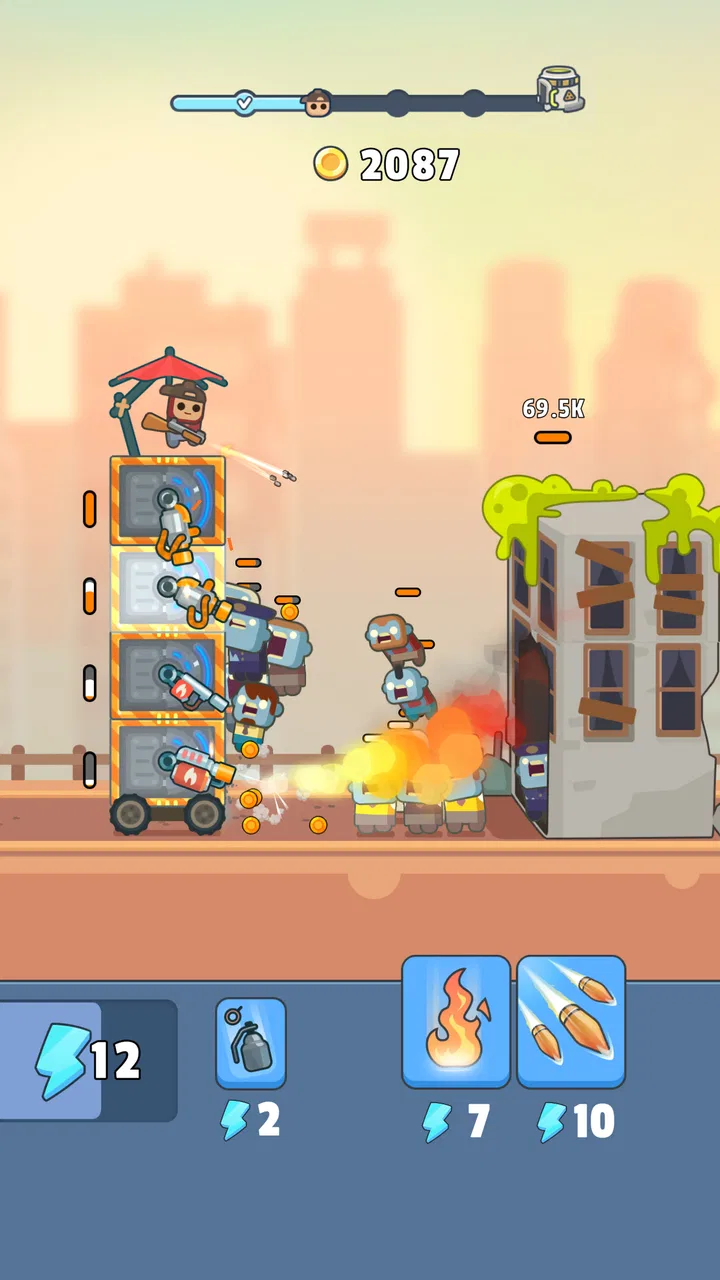
I approached TDS - Tower Destiny Survive expecting a quick zombie action game, but its most important idea is more specific: your progress depends on building, equipping, and upgrading a tower while surviving increasingly demanding waves. That focus gives the game a clear rhythm. I am not simply moving through a level and shooting until it ends; I am making short-term defensive decisions, choosing how to strengthen my position, and then seeing whether those choices hold when the next crowd arrives.
That makes this a useful pick for players who enjoy compact sessions with a little planning behind the action. It is free to play, belongs to the action category, and comes from SayGames Ltd. The game is rated for Everyone 10+, which fits its accessible presentation, although the zombie theme and constant combat will not appeal to every younger player. It was released on April 5, 2024, and version 1.11.0 is the version I would look for when installing it on a device running Android 8.0 or later.
Why the tower-building loop matters
The tower is more than a backdrop. It gives the game a fixed defensive problem that is easy to understand but harder to solve well. Zombies are coming, your structure is the place you must protect, and every improvement needs to serve that goal. I like this setup because it turns each wave into a small test of preparation rather than a disconnected action scene.
You May Also Like

 Blood Strike: 2.5 Anniversary
Blood Strike’s Loadouts Turn Every Drop Into a Tactical Gamble
A close look at Blood Strike’s custom loadouts: how fast access to signature weapons reshapes its battle royale rhythm, rewards preparation, and narrows the gap between fights.

 Pandora - Music & Podcasts
Pandora’s Music Is Easy to Start, but Harder to Recover
Pandora’s strength is its low-effort path from a seed to a station. Its weak spot is how much confidence it asks you to place in connection, setup, and quiet recovery.

 8 Ball Pool
 Is Built on Rivalries, Rematches, and Routine
A close look at the rivalries, rematches, shared routines, and unanswered safety questions that turn a quick pool match into a persistent mobile community.

 Samsung Music
’s Quiet Strength Is Playing What You Already Own
Its reach comes less from spectacle than from dependable access to a personal library. That simplicity is both the app’s strongest retention engine and its ceiling.

 AccuWeather: Weather Radar
AccuWeather Review: A Quick, Clear Forecast for Everyday Decisions
For everyday plans, the best forecast is the one you can understand quickly. AccuWeather makes rain timing, radar, and local conditions easy to act on, with a few trade-offs.

 Hill Climb Racing
Why Hill Climb Racing Still Turns Crashes Into One More Run
A tiny car, a bumpy hill and one more upgrade: Hill Climb Racing keeps resurfacing because its simple chaos makes every near-miss feel personal.
More From Our News Desk



In many mobile action games, the main decision is whether to attack faster or move more efficiently. Here, the stronger question is how to make the tower survive the pressure. A powerful upgrade may help immediately, while a different improvement may create a better foundation for later waves. That tension is what keeps the loop from feeling like a purely automatic battle.
The real strength is the connection between construction and survival. Building is not a separate menu activity that exists only to decorate the experience. It changes how confident I feel when the next wave begins. Equipping and upgrading also give the action a sense of direction: I am working toward a sturdier defensive setup instead of fighting without a clear reason.
The store summary describes the central task in simple terms, but the practical effect is more interesting. The tower creates a pause between threats. I can think about what went wrong, decide what deserves attention, and then return to the action with a plan. That makes the game particularly comfortable for short breaks, because a session has a recognizable cycle rather than requiring a long uninterrupted commitment.
Construction is useful only when it answers a problem
My best advice is not to treat every upgrade as automatically valuable. If a wave overwhelms the tower quickly, the answer may be stronger equipment. If the tower survives but the battle drags on, offensive improvement may matter more. The useful habit is to identify the reason for failure before spending resources. That small step prevents random upgrading, which can make progress feel slower than it needs to be.
This is one of the less obvious lessons in the game. A player who upgrades whatever is available may still advance, but the tower will feel inconsistent. A player who watches the shape of each defeat can make more deliberate choices. The game therefore rewards attention even when the controls and overall presentation remain approachable.
I also found that the tower changes how I judge risk. In a conventional action game, taking damage can sometimes be corrected by retreating or finding a safer position. A defensive tower feels less forgiving because damage to the central objective affects the whole attempt. That makes preparation meaningful, but it can also make a poor decision feel more expensive than a missed attack in a standard shooter.
How the action feels during an ordinary session
The practical flow is easy to settle into. I begin by strengthening the tower and preparing its equipment, then face a wave of zombies. When the danger has passed, I review my position and decide what should be improved before continuing. This structure keeps the game readable: preparation, pressure, recovery, and another decision.
That clarity is important on a phone. I do not need a long explanation before understanding the immediate objective. At the same time, the tower system gives me something to think about after the first few encounters. The experience is more satisfying when I stop treating each wave as an isolated fight and start treating it as evidence about the quality of my setup.
For a realistic everyday example, I could play during a short commute or while waiting for an appointment. I would complete a few waves, notice that my tower is being damaged earlier than expected, and use the next pause to improve the weak point. If I only have a few minutes, the game still provides a complete little decision cycle. If I have longer, the same loop can hold my attention because each new wave asks whether the previous preparation was enough.
That flexibility is one of its strongest practical qualities. It does not require the emotional investment of a large role-playing game, yet it is more deliberate than a disposable tap-to-attack experience. I can play casually, but I get more from it when I pay attention to the relationship between equipment, upgrades, and incoming pressure.
A simple method for making better progress
I recommend using a three-step check after a difficult wave. First, notice whether the tower is losing health too quickly. Second, decide whether the problem is insufficient protection or insufficient damage. Third, make one focused improvement rather than scattering resources across several unrelated choices. This approach keeps the tower’s development understandable and makes it easier to tell whether an upgrade actually helped.
Another useful habit is to avoid spending everything immediately just because an improvement is available. Holding some flexibility can be valuable when the next wave exposes a different weakness. The game’s appeal comes from making choices under pressure, so removing all choice through impulsive spending works against its best feature.
I would also suggest treating failed attempts as information rather than simply as losses. A failed defense tells me whether the tower needs more preparation before the next push. That mindset makes the action feel less frustrating, especially for players who usually dislike repeating a stage or encounter.
Where it differs from familiar action alternatives
Compared with a traditional mobile shooter, this game places more emphasis on the condition of a fixed defensive position. In a shooter, movement and immediate aim may dominate the experience. Here, the tower makes preparation just as important as the moment-to-moment battle. Players who want constant movement may find that slower and less exciting, while players who enjoy watching a plan survive will probably appreciate it.
It also differs from a pure tower-defense game. The presentation is framed as action, and the satisfaction comes from combining defensive development with the urgency of zombie waves. It is not simply a quiet planning board where I place defenses and wait. The appeal sits between direct combat and structured defense, which gives it a more active feel than traditional tower management.
Against large strategy games, the advantage is accessibility. I can understand the immediate task without learning a vast economy or a complicated map. The trade-off is depth: anyone looking for a sprawling campaign, extensive world exploration, or a huge number of interconnected systems may find this focused loop too narrow. TDS - Tower Destiny Survive works best when its limits are treated as part of the design rather than as missing features.
The best situation for playing it
The ideal player is someone who enjoys a repeatable action loop and wants a meaningful decision between waves. I would recommend it to a person who likes zombies, compact progression, and the feeling of improving a defensive position over time. It is especially suitable for players who want something that can be picked up quickly but still rewards noticing patterns.
It is also a good match for someone who likes games with clear goals. The tower gives every upgrade a practical purpose, and the zombie waves provide an immediate reason to keep improving. I never have to wonder what the broader objective is: survive, strengthen the tower, and prepare for what comes next.
On the other hand, I would not choose it for a player who wants a relaxed, story-heavy adventure. The focus is on repeated combat and development, not on exploring characters or discovering a detailed narrative. I would also steer away from it if the idea of defending one structure sounds restrictive. That fixed focus is precisely what makes the game coherent, but it can feel repetitive if a player needs constant scenery and radically different objectives.
There is another important distinction for people choosing between this and a conventional action game. If you prefer winning through quick reactions alone, the upgrade layer may feel like an interruption. If you enjoy understanding why a defense failed and adjusting your setup, it becomes the part that gives the action purpose.
What the free download really means
The game can be downloaded free, but it includes in-app purchases ranging from $0.99 to $99.99 per item. That matters because the progression loop is built around improving the tower, equipment, and related choices. I would approach the purchase system carefully and decide in advance whether I am comfortable playing without spending or setting a personal limit.
For me, the sensible way to evaluate the game is to begin with the free experience and see whether the core loop is enjoyable before considering any optional purchase. Spending money cannot replace understanding which part of the tower is failing. A player who buys upgrades without learning the rhythm may move forward more quickly but gain less satisfaction from the strategy.
This is also why the game may not suit someone who dislikes any purchase pressure in free mobile games. Even when the action itself is appealing, the presence of a broad purchase range can make the experience feel less comfortable for players who want a completely fixed-cost product. A paid action game with a single upfront price may be a better choice for that audience.
Age, device, and everyday accessibility
The Everyone 10+ rating makes the game broadly approachable, but parents should still consider whether zombie combat is suitable for the individual child. The theme is central to the experience, so the age label should not be treated as a promise that every family will find it appropriate.
Android users need version 8.0 or later. That requirement is modest enough for many devices, although performance can still vary between phones. Because the game depends on repeated waves and quick decisions, a device that handles the action smoothly will make the tower loop more enjoyable than an older phone that stutters during busy moments.
The game has reached over ten million installs, with an average rating of 4.4 from around 257 thousand ratings and roughly 6.2 thousand written reviews. Those figures suggest that the basic concept has found a substantial audience, but they should not replace personal judgment. The important question is whether the combination of zombie waves and tower development matches the way you like to play.
The trade-offs behind the strongest feature
The tower system gives the game identity, but it also creates its main limitation. Because the central objective remains consistent, the experience can become predictable for players who need constant mechanical change. The loop is satisfying when I am refining a defense, yet less compelling when I want every encounter to introduce an entirely new kind of challenge.
There is also a balance between accessibility and depth. The game is easy to understand, which makes it friendly for casual sessions. However, players who expect the intricate planning of a full strategy title may find the decision-making more compact. I see that as a deliberate trade-off rather than a flaw, but it still determines who will enjoy the game over a longer period.
The purchase range creates another trade-off. Free access lowers the barrier to trying the game, while optional items can affect how comfortable different players feel about progression. My recommendation is to judge the game by the quality of its basic loop first. If the tower-building decisions are not enjoyable without spending, purchases are unlikely to solve the underlying problem.
Repetition is the final consideration. The wave structure is exactly what makes short sessions convenient, but repeated waves can also expose the limits of the formula. I would play it alongside other games rather than expecting it to replace every action experience on my phone. It is strongest as a focused, repeatable activity.
Who gains the most from this design
The biggest winners are players who like seeing a defensive plan improve in small steps. They will notice that the tower is not merely something to protect; it is a record of earlier decisions. Each upgrade has more meaning when connected to a specific weakness, and each successful defense feels like evidence that the preparation worked.
Casual players benefit from the compact structure, while more thoughtful players can add their own discipline by tracking why a wave caused trouble. That combination is unusual enough to make the game worth trying. It offers an approachable surface without removing every opportunity to make a poor or smart decision.
Players who should skip it are those looking for deep exploration, a strong narrative, or purely skill-based combat with no development layer. They may find the tower focus too repetitive or the upgrade decisions too central. A conventional shooter is better for immediate movement and reaction, while a larger strategy game is better for complex long-term planning.
For everyone else, I think the game is worth a trial. The most effective way to enjoy it is to focus on the tower as a problem to solve, not as a checklist of upgrades. Watch what each zombie wave reveals, improve the specific weakness, and resist the urge to spend or upgrade without a reason. That approach brings out the thoughtful side of the action.
After spending time with it, I see TDS - Tower Destiny Survive as a focused mobile action game with one clear promise: build a stronger position and find out whether it can withstand the next threat. It does not try to be a full strategy epic or a story-driven zombie adventure. Instead, it offers a compact loop that works well in everyday gaps, provided you enjoy repetition and are comfortable with free-to-play purchases.
My final recommendation is positive for players who want short zombie battles with preparation behind them. The tower-building capability is not just an extra feature; it changes how I play, how I interpret failure, and how I decide what to do next. If you enjoy turning each failed defense into a better setup, this is the part of the game most likely to keep you coming back.
FAQs for TDS - Tower Destiny Survive
01What is the main objective of TDS - Tower Destiny Survive?
In TDS - Tower Destiny Survive, the primary objective is to strategically defend your tower against waves of enemies. Players must build and upgrade various defensive structures, manage resources efficiently, and utilize special abilities to survive as long as possible. The game combines elements of strategy, resource management, and action to provide an engaging experience.
02Are there in-app purchases in TDS - Tower Destiny Survive?
Yes, TDS - Tower Destiny Survive includes in-app purchases. These purchases can enhance gameplay by providing additional resources, unlocking special abilities, or removing ads. However, all content can be accessed through regular gameplay, making in-app purchases optional for players who prefer to progress without spending money.
03Does TDS - Tower Destiny Survive require an internet connection?
TDS - Tower Destiny Survive can be played offline, allowing players to enjoy the game without an internet connection. However, certain features, such as leaderboards and cloud saving, require a connection. Playing online can also enhance the experience by enabling multiplayer modes and accessing regular updates.
04What devices are compatible with TDS - Tower Destiny Survive?
TDS - Tower Destiny Survive is compatible with both Android and iOS devices. It requires Android version 5.0 or higher and iOS version 10.0 or later. The game is optimized for a range of devices, ensuring smooth gameplay and a high-quality experience across smartphones and tablets.
05How does TDS - Tower Destiny Survive handle game progression and difficulty?
TDS - Tower Destiny Survive gradually increases in difficulty as players advance through levels. This progression ensures that players remain challenged while improving their skills. The game includes various difficulty settings and modes, allowing users to tailor the experience to their preferences, whether they seek a casual or intense challenge.
Pros
- Engaging tower defense gameplay.
- Variety of unique towers to unlock.
- Offline mode available.
- Challenging levels with increasing difficulty.
- Regular updates with new content.
Cons
- In-app purchases can be pricey.
- Ads can be intrusive at times.
- Some levels feel repetitive.
- Limited customization options.
- Requires frequent internet connection for updates.

TDS - Tower Destiny Survive
Gallery